Archive
Secret Ingredient Part II
Just a bit of follow up on the big BBQ from last week. After cleaning out the smoker from a winter’s neglect, and scrubbing this thing top to bottom, we were ready to go.
The first thing we did was take the meat out of the fridge early. Let it get close to room temp. If it goes in the smoker too cold, they say that you could get creosote build up. Even if this isn’t true, I still don’t think you want the outside of the meat to be cooking while the inside is iced cold. 2-3 hours at room temperature for these larger cuts should be just about right.
Then it was time to fire up the chimney. You never want to use lighter fluid to start your coals. The marriage of meat and fire is a holy union. Adding petroleum products is unnatural. It’d be like spiking your chili with kerosene. For smoking or even just for burgers, do yourself and your guests a favor and get a charcoal chimney starter like this one.
The trick is to know your smoker. You eventually get a feel for what size fire you need, and how much air to give it. Remember that more air = hotter fire = quicker your fuel is spent. Try to build a fire that will hold your temp, more or less, at medium air flow. And unless you have a major flare up, only adjust the air flow at the fire-box, and never at the chimney. You do not want smoke sitting in the main chamber of the smoker for a long time. The chimney should remain all the way open.
Once you hit a temperature between 200° and 250° F, the meat goes on and, if you’re doing a large cut like a pork shoulder or a brisket, your job for the next 12 hours or so it to try to keep it in that temperature range. Too high, and the meat will dry out. Too low and it won’t cook properly. Hygiene, hygiene.
Here’s where you can cheat. Since staying up for 12 hours before even lunch is a bit impractical, there is a shortcut you can take. Larger cuts of meat will have absorbed about all the smoke that they’re going to after about 6-7 hours. Anything beyond that point you’re basically using your smoker as a charcoal and/or wood burning oven. And if all you really need is an oven, there’s nothing stopping you from using the one in your kitchen.
Wrap your pork shoulder or brisket in tinfoil. Place in a 250° degree oven. Close off the air flow on your smoker. Set your alarm for about 12 hours from when you first put the food on. Take a nap.
When everything’s done, let the meat rest in the tinfoil for a while. At least an hour. By then it should be about cool enough to handle. Start with a couple of forks and pull that mother apart. Or chop it up with a big knife if that’s what floats your boat. Either way, you’re ready to eat.
Graduation BBQ from Chris McIntyre on Vimeo.
The Museum Of Libraries

Libraries today are endangered. The news is filled with constant stories of library closings and cutbacks. At the same time, we’re living an era of unprecedented access to information. As I write this, it’s almost midnight and, lets face it, even if a library near me were open right now, I probably shouldn’t be driving. But sitting right here, I can find out the gross weight of the 2002 sardine catch (about 22 million tonnes) with just a couple minutes on a search engine. Everything’s different in a world that is constantly connected, and where information flows more or less freely to those who know how to access it.
Laura Miller writes today about Why Libraries Still Matter, but honestly I think she misses the point. As far as I can tell, her argument is that Libraries are keepers of history, and history is more than just words on a page. She writes:
Also, not everything a library collects is a scannable book or document. The NYPL’s anniversary exhibit includes such treasures of print culture as a Gutenberg Bible, a copy of the Declaration of Independence written in Thomas Jefferson’s hand, and a first quarto edition of “King Lear.” It also features the personal effects of writers, such as Jack Kerouac’s rolling papers, harmonica and Valium box (with notes scribbled on it).
…
I’ve always found the material presence of such objects quietly thrilling. They remind me that literary figures, who sometimes seem so Olympian, also muddle through an ordinary human existence like all the rest of us.
She’s right, of course. These objects are a part of our history, and provide important context to works that we sometimes absentmindedly imagine appearing ex nihilo into our collective consciousness.
This brings up the fact that libraries serve multiple functions. Miller is extolling the library’s role as caretaker of precious artifacts from our cultural heritage. Of course, we already have an institution who collects objects as a way of adding to our understanding of history. It’s called a museum, right? So why should this be responsibility be split between two different spaces? How do we decide what goes into a library, and what goes in a museum? Miller isn’t clear. She does broach the topic when she writes:
Unlike the Dickens and Brontë memorabilia, which could just as easily be enshrined elsewhere, these are once-mundane objects you’d never find in a museum, but they’re an important part of our written culture and well worth saving.
The problem here is that it’s not true that you would never find such mundane objects in a museum. In fact, there are museums dedicated to practically any aspect of human life, thought, or endeavor that you could imagine. Last year MoMA had a long running exhibit about post-War kitchen design. If that’s not up your ally you can travel to Indiana, PA for the Jimmy Stewart Museum.
The point is that I’m sure that you could find a reputable museum to house Jack Kerouac’s rolling papers and harmonica. In a sense, though, we have. You can look at large, metropolitan libraries as being simply museums that allow you to touch, man handle, and even take home (some of) the objects. Lets call this the object oriented view of libraries. In this view, the important aspect of the library is the objects within. Whether it be the physical books, or the displayed items, or the public computer terminals.
Libraries, though, aren’t the only game in town when it comes to holding physical objects for safe keeping. I wouldn’t even say they’re the best. I might be biased after dating a librarian for the last couple of years, but I honestly think that the true value of a library, the part that is worth cultivating, is in what you could call the curation oriented view of a library’s service.
You have many ways to interact with information. I have more information at my fingertips than I could absorb in a lifetime. But if I just sit randomly Googeling most of what I get is background noise. A good library system should not care whether you’re looking in a dead-tree book, an ebook, or a blog post. It’s mission should be to act as a filter of sorts. The library can help you make sense of a chaotic world. And that’s something that everyone can use sometimes. Don’t think because you’re aware of all internet traditions that you can’t find something to take advantage of there.
So will we see these two functions grow farther apart? Or will they start to blur together? In the future, maybe we’ll see libraries become more like museums, with a reference desk pushed in the back behind a display of Judy Garland’s potato chip collection. That wouldn’t surprise me, but it would be a shame. Computers are great at gving you information you want, but so far none of them can give you what you need.
Secret Ingredient
My sister’s graduating. She’s gone through Rutgers School Of Nursing’s graduate program and, after going through more years than I can count, she is finished.
An event like this deserves a party. So it was decided to throw a BBQ for about 60 people. And her family is doing the catering. Myself included.
With that many people, it’s no sense trying to have what you might think of as a normal, post-war, North Eastern, suburban backyard cookout. You would spend hours at the grill rotating burgers. As soon as you feed one batch of people, the last has finished digesting and is getting back in line. This is not conducive to having a good time at a party.
True barbecue isn’t like that. The key to traditional ‘cue is a mountain of meat cooked with smoke at low temps until its’ falling apart tender. This is something I’ll take over burger slinging any day. When it comes to BBQ, my tastes lean towards pork shoulder with thin, vinegar based sauce. It hits all 4 taste sensations: spicy, smokey, tangy and fatty.
Even finding properly cooked pulled pork in New Jersey can be tough, so about 10 years ago I set out to try to do it myself. I started by buying some cheap contraption shaped like a barrel smoker at Home Depot. It was made of some flimsy metal and could barely fit one rack of ribs, but hey, it had an offset smoke box like the ones in the pictures, so I figured I was assured success. After some trial and error, I was able to get food that was technically edible out of that thing, but never much more.
I decided that I need to upgrade, so I bought ANOTHER ONE from Home Depot. This time it was a different brand, slightly larger, but still made of some unknown alloy, and only about an 1/8″ thickness. If the idea of BBQ is keeping a consistent low temperature, then trying to use this barrel smoker was like driving with your elbows. Your only hit the right angle by luck, and then soon the road conditions change and you’re screwed again.
Eventually I got a good quality barrel smoker. It’s 1/2 ” hand welded thick cast iron. It’s from Oklahoma Smoker Company. I would definitely recommend this company, but if you’re interested there are other companies out there that make something similar.
But lets say that you’re not as crazy as I am, and don’t want to invest in a huge rig. Water smokers are reasonably cheap and fairly useable. Even a regular Weber grill, with the coals on one side and the meat on the other would be better than some of these knock off barrel types you find at some hardware stores.
Don’t be fooled. If you’re looking to get started in BBQ, read Smoke and Spice by Bill and Cheryl Jamison. It’s a good introduction into what is traditional BBQ. It’s a great starting place, with tips on some commonly used set ups. It’ll get you pointed in the right direction. Then you can start experimenting. Come up with a style unique to your own back yard.
Update: Spelling
This Is Where We Should Feel Good, Right?
Superhero comics were going through a bit of a crisis when I started reading them in the late 80’s and early 90’s. For the previous 30 years, comics had mostly consisted of heroes in brightly colored spandex fighting villains bent on personal enrichment at all costs. Each issue was a modernized variation on an old Western, with each side wearing white or black.
Eventually, the kids had read those comics started growing up, and they demanded that their comics grow up with them. By this time the stories started to reflect real world that doesn’t dress protagonists up in bright colors to make it easy to tell one side from the other.
As a superpower, the US had been acting like an 80’s comic book hero. We were often dragged into impossible situations. Our actions were ambiguous. Actions that many in the US see as good, or at least as defensible (especially by those in the largely white, upper-middle class power structure that controls both political parties) were seen around the world as bullying at best. It was hard to say that that we were every doing right simply because it was the right thing to do.
For the last decade, though, we had one yardstick to measure ourselves against. Osama Bin Laden was something truly rare: an unambiguous bad guy. He was practically a cartoon supervillain. For once, and unfortunately at a terrible cost, the US held the moral high ground by any measure. We should have realized that the true test to was get as far away from him, morally, as possible. We had the chance to prove ourselves his opposite.
And we blew it. For the past decade we have taken what could have been a an opportunity to rededicate ourselves to being a force of good in the world and have instead allowed our nation to become a funhouse mirror version of itself. And every one of us is responsible. We’ve turned on each other by allowing our civil liberties to be eroded. We’ve turned on others by claiming the right to invade other countries and treat their citizens as non-entities.
I don’t have much to say about the death of Osama Bin Laden. I wish that he had been taken alive to answer for his crimes, but we all knew it couldn’t end that way. What I do know is comic books. And in comics, once the bad guy is killed, everything goes back to the way it used to be. I hope that is true. I hope that, now that this chapter in US History is over, we can stop being afraid of the bad guy for a bit, and start worrying about our soul.
Johnny Thunders
Johnny Thunders died 20 years ago today. So take a moment to remember one of the greatest punk/rock guitar players to ever turn 2 chords and a sneer into pure fucking magic.
In The Year 2088…
Japan becomes all robot economy.
Missed this by a couple days, but check it out, this is awesome. I’m totally going to print this out so I can keep score for the next 90 years.
What Do Spys Do Exactly?
My favorite movie series is the James Bond franchise. Sure they have their goofy moments. We’re not exactly talking about the well crated realism of The Wire here. Still, I think at their best they try to at least trick you into believing that they’re somewhat plausible.
Most of the little things I can overlook. The guy who can throw a hat so hard it’ll cut the head off a marble statue? No problem. Christopher Lee building a laser powered by the sun, and run by a machine that needs vats of coolant no warmer than absolute zero, or the whole thing blows up? Sure, why not? But what gets me is that our hero, James Bond, and his team of crackerjack spys at British Military Intelligence never seem to have any idea what these bad guys are doing.
It’s a weird ritual at the beginning of most Bond movies that M calls 007 into his office to brief him on his target. Then Bond makes a show of already having this character’s case file memorized. He knows plenty of intimate details about this guy (and it’s always a guy), like what his vices are and where he vacations. But for some reason something like “he’s spent the past 3 years working on a team of dozens of engineers and hundreds of lackies building a supertanker that can swallow nuclear submarines” or anything to that effect.
So how are we to believe that this great, almost omniscient spy organization can consistantly miss something like this being built in the waters off Sardina:
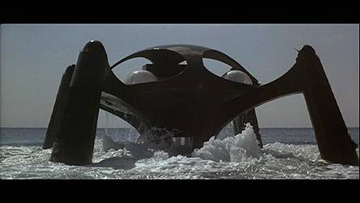 This is the sort of thing that would cost millions of dollars! Involve hundreds of subcontractors. Use metric tons of steel. Necessitate some of the worlds best engineers. And MI6, the KGB, and the CIA were all caught off guard?
The net effect of years of Bond movies has been that I now see the world’s great architectural masterpieces as potential supervillian hideouts. The pyramid outside the Louvre? Obviously where they are creating an army of zombie/vampire hybrids. CN Tower in Toronto? Can transmit death rays at the drop of a hat. You laugh now, but do you really think that was built just to pull in the rubes? Who’s crazy now?
Japan Closes Area Around Nuclear Facility
It’s been over a month since this thing started melting down and they’re just now setting up a perimeter. Is this good news or bad?
Sweet Caroline
I admit that I’ve always avoided Sweet Caroline at karaoke. We’ve always had our group songs that we do. Love Train. What’s So Funny (’bout Peace Love And Understanding). But last night we had a big, drunken, rowdy gang taking over the Sudsy Mug, and there was no way we could do anything with too many words. We tackled Elvis earlier in the night, but this was Joe McCall’s birthday, and we were closing out the night.
So the question came down. What song do we do? There wasn’t time to go through the book. It’s a massive sea of songs to troll through. At times like this you need a hit. This will be the song that all the barflies and hipsters and casualties will have running through their heads when they leave.
I’m not saying I made the right call. We could maybe have done a passable version of the Beatle’s Birthday. It could have been the night for a wild card, like Wagon Wheel. But it felt like something big needed to be done.
So Sweet Caroline it was. This was some “in case of emergency break glass” type shit. We gathered around the mics and started into one of the weirdest classic pop songs in the cannon. It’s half Vegas style schmaltz and half jazz age burlesque. There’s a slow build. The chords methodically build up the scale. Then there’s release. We’re all at the top of our lungs and the song hits it’s stride. It was drunken karaoke melee at its best. The song is a roller-coaster and everyone in the bar was along for the ride. Good times never seemed so good.
Old Habbits Die Hard
Listened to She & Him Vol 1 last night. Forgot how good an album that was.
 Nothing Was Delivered