Archive
CSA Week 6: Fritters!
It’s week six and I think we’ve all had all the greens-sautéed-with-pasta as we can stand. Today the idea was for something a bit more substantial.
We decided on fritters. The farmers markets are full of Jersey zucchini, squash, and peppers. Mix those with whatever greens you have on hand, throw in some binder, and fry the suckers.
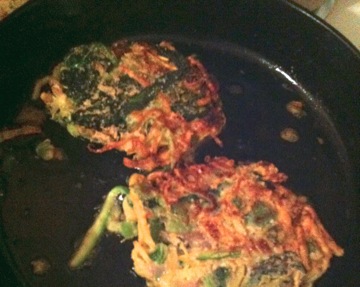
The recipe is easy enough. Cut two zucchinis in thin strips. Julienne, as they say. Dice up one green bell pepper and one shallot.
Blanche some greens. How much? Well, remember that when you cook greens, they’re going to shrink quite a bit, so the rule of thumb is to just way more than you think you’ll need. Clean them, stem them, and place them in gently boiling water for a couple of minutes, until the leaves start getting tender. Then quickly transfer to ice water to stop the cooking.
Then throw your zucchini, pepper, shallots, greens, and anything else diced or julienned that you feel like (any root vegetable would be pretty great, I thinking carrots next time) into a bowl. In a separate bowl, beat 1 egg with about 2 teaspoons of water, then pour it over your veggies. Salt and pepper liberally.
Meanwhile, get a cast iron skillet going with about 1/4 to 1/2″ of oil boiling. fill a dish with about 1/2″ of flour, and season with salt and pepper. Then take a handful of your veggie / egg collaboration and toss it in the flour. Take it out of the flour, form a patty, and pack it down pretty hard. They don’t need to be handled the the velvet gloves that burgers do. Squish them down, slide the fritter into your oil, and let it cook.
Once the fritter is browning on one side, flip it and cook on the other. That’s about it. You could serve with sour cream or guacamole. We happened to have some pesto mayo made up, so we used that. For a side dish we each had a handful of animal crackers ’cause we’re grown ups and we can do that, thank you very much.
RIP Sparrow
I’ve become addicted to the Sparrow email client for the iPhone and especially the Mac. Looks like they’ve been bought by Google, who plans to bring the developers in house to work on who knows what related to Gmail, letting Sparrow die on the vine.
We will continue to make available our existing products, and we will provide support and critical updates to our users. However, as we’ll be busy with new projects at Google, we do not plan to release new features for the Sparrow apps.
I’ll be honest, I didn’t see this one coming. Sparrow seemed like they were making a nice living selling their app. They were making something useful and getting paid, and we were getting a top notch email client. Seemed like a win-win. You always worry about the free online services. You know that eventually they have to find a way to cash out. When I pay for an app or a service, I suppose I imagine they’re in it for the long haul.
Still, Sparrow won’t stop working any time soon, so what’s really lost here is the potential for what they could have done with Sparrow in the future. It’s like seeing writer change careers in the middle of a trilogy. You still have the books that had been produced, but there’s a feeling that the story was never completed.
Crocodile Found Wandering Ocean Gate, NJ
From the Asbury Park Press:
“The dangers speak for themselves when you have an animal such as this roaming loose in a compact residential neighborhood like Ocean Gate,” Fisher said. “Fortunately it wasn’t full-grown, but nevertheless, the dangers are still inherent.”
Every so often one of these creatures will make their way up the Intracoastal Waterway to the Jersey Shore. This time someone seems to have brought one up here on purpose and let it lose.
Boil Water Order Lifted for Long Branch
For Long Branch folks, try have lifted the Boil Water warning. Run the taps for a minute, and then go right ahead. The water’s fine.
Dispensing Advice Without a Licence
Agrigirl catches the State of North Carolina threatening a food writer with legal action for promoting his fad diet of choice.
Apparently the North Carolina Board of Dietetics/Nutrition has informed Steve that he is unable to give readers advice on diet, whether free or for compensation, because in doing so he is conducting the unlicensed, and therefore criminal, practice of dietetics. The North Carolina Board went on to tell Steve that even his private emails and telephone calls with readers and friends are illegal, as is his fee-based coaching. Steve was left with a red-lined document letting him know what he can and cannot say without a government-issued license from the North Carolina Board of Dietetics/Nutrition.
This sounds almost comically over the line. While I have no love for people trying to profit off the latest fitness trends, this is almost the definition of a slippery slope. What is next, are not going to be allowed to discuss nutrition with friends or coworkers for fear that someone is part of a secret Diet Police? Will parents be banned from teaching their children how to cook, for fear they may use hydrogenated fats?
Nutrition is important, and it’s complicated and hard to get right. Looking back, I wish that my parents had been stricter about the foods we ate. I was well into my 20s before I learned to eat right and settled at a fairly healthy weight. I understand the government’s impulse to keep the quacks at bay. But food is too much a part of everyday life. It fills our Instagrams and forges friendships. And, not to put too fine a point on it, it gives bloggers something to ramble on about. There are ways to encourage healthy eating that are better than trying to control who talks about food. This is America, damnit. We all talk about food.
Home Made Pizza In The Summer
It takes a special kind of crazy to coax a 550º temperature out of your oven in the dead of summer. Maybe I was just running out of recipes for my greens. Maybe I just had the feeling that no matter how good the pizza in my area was, I could do better. Whatever the reason, despite knowing the forecast of continuing heat and humidity, I decided to make some pizza dough the other day.
Proper pizza dough is never a one hour rise and bake. If you see a recipe that calls for mixing flour, water, and yeast together, letting it sit for an hour, and then cooking your pizza, you’re best bet is to move along. Sure you might end up with something that resembles a pizza crust, at least superficially. It will be flat and it will support a layer of cheese. At best, though, it’ll end up tasting like drywall. If you want pizza NOW, order in. The dough you want is going to take a couple of days in the fridge to reach it’s full potential
Today we, the intrepid, decided to soldier on. While every fan in the apartment set to spinning, we kicked the oven into high gear.
I always like to make one pie per person. That’s just enough to leave you uncomfortably full, which is where you should be after putting up with so much just to start making pizza in the first place. Each dough has been measured out to about 13 oz. We take the dough and shape it into a ball, stretching the outside as much as we can without tearing the dough, creating a surface tension. When the yeast create CO2 during their proofing, this surface tension will capture the gas and help the dough to raise. This part is very important when cooking pizza. You tuck the dough into itself to create a tight ball, then pinch the bottom closed. Then you slap the doughball down on your work surface and slide it around to even out the seal. It’s hard to describe. There are videos on YouTube, but none of them are right.
After a second raise, the dough is ready to be worked. You can tell if it’s ready by poking it. Seriously. If you give it a gentle poke and it doesn’t spring right back, then it’s ready to go.
After flattening out the first pie, we dressed this with some fresh mozzarella, some blue cheese, and blanched napa cabbage. I got my mozzarella at Taste Of Italy in Tinton Falls. The flavor was good, fresh and well seasoned, but I found the texture to be watery. Creating a good ball of fresh cheese can be hit or miss. It’s a very physical activity. The milky water needs to be wrung out thoroughly without damaging the curds.

I will admit I never had cabbage pizza before, unless you count sauerkraut (don’t ask). It was good, with just a bit of grassy flavor to cut through the richness of the cheese. The dough was high hydration, approximately 67%. As you can see we got some tremendous oven spring.

Some hobbyists can get caught up in the tools. This is true with any pass time. Sure we all like to have the nice Cuisinart for making the dough, or a professional 3 by 6 plastic container for raising our doughs. But all of those things are simply luxuries. What’s really important in pizza making is your ingredients and your oven. Without having a decent machine in your kitchen and knowing how to use it, the pizza will never get that perfect crisp/tender/chewy texture. I’m still learning with this oven here. The undercarriage is getting cooked perfectly, but the tops are still a bit blonde for my taste. If I leave them in much longer, though, I’ll risk burning the bottom. It’s going to take a bit more tinkering to get the settings just right.
As I write this it is 90º and I do not have air conditioning. This is the time of year when you put away your break and pizza making skills for a few months. The oven is not doing you any favors. Sure, you can always make grilled pizza, and the diehards will simply build a wood fired oven in their back yards. But for me, this was a good way to end the season. In the mean time, I’ll probably take the time to explore the local pizza joints in Monmouth County, and look forward to getting back in the kitchen come fall.
How To Resize PDFs in Lion
Nifty trick and saved my bacon today.
Long story short, Preview in Lion (and also, I’m assuming, Mountain Lion) lets you chose File -> Export. Towards the bottom of the Save screen, you’ll see the option for Quartz Filters. Choose Reduce File Size. If the resulting PDF compresses your images too much, you can create a custom filter with OS X’s Color Sync app.
Then to use this new filter just right click on the PDF you want to compress, choose Open With -> Color Sync, pick the filter you want, and hit Apply.
Josh Ritter Live at the Stone Pony
Josh Ritter knows how to work an audience. He comes on stage beaming. I have never seem a man do happy to be performing in front of an audience. He is constantly in motion, which is unusual for a folk musician. Perhaps that’s why he put together a powerful band of musicians. The full experience does push his songs over the coffeehouse singer-songwriter mark.
Tonight he played before a packed house at the Stone Pony in Asbury Park. It was a warm up night for his tour. He told the crowd that the band hadn’t performed in 6 months. For musicians that can be a career.
There were many new songs, and I will admit that some of the old ones were barely familiar to me while some in the crowd sang along to every word. Ritter clearly relished this, often pulling away from the mic to allow the voices from the audience a chance to shine through.
Until you spend a couple if hours with the man and his songs, you might not realize the extent that religious imagery dominates his songwriting. His narratives steal equally from folk tradition and religious tales. What’s striking, however, is how how playful the biblical characters are. There’s no great deference given. They joke and they kid and they come on to King Arthur’s nights, and often represent sexual ecstasy. This is no bloodless born again philosophy. Saints are never too far away from scoundrels.
The highlight of the night was a rambunctious version of “Harrisburg” that segued into “Happiness Is A Warm Gun”. Josh stopped right before the high note. His band fell silent. He unbuttoned his collar. Took a deep breath. This was totally out of his range. Then he fucking nailed that high note. Ghaaaaaa-uh-uh-un.
Then it was back to “Harrisburg”. But the message was clear. Nothing is out of bounds.
CSA Week 4: It’s Not Easy Having Greens
Like mot things in life, I wish I had been more diligent in blogging my weekly CSA bundle. So far, it’s been an enjoyable challenge to come home with a bushel of food, mostly greens, and try to figure out a way to live on these that doesn’t require eating the same meal every day for a month. The trick is to not always insist on your CSA goodies taking center stage. Variety is the spice of life. Focus on the pork shoulder you find on sale that week, for instance, and let your veggies play a supporting role.
The first thing to do is to make a salad while everything is super fresh. It wouldn’t be a bad idea to plan your weekly meals in order of what needs the most cooking. The fresh lettuce, straight from the garden, will never taste as good as it does the day you pick it. Meanwhile, heartier kale can survive a longer wait.
For dinner on Sunday, the plan was to stir fry some greens with chicken sausage I picked up from Stop and Shop, and then toss it all with some pasta. That didn’t turn out so well, as the sausage decided to turn itself rancid. Luckily, Sunday was a nice day for a walk. Erin and I moseyed on down to the grocery store and exchanged the meat for a hunk of fresh mozzarella. On the way back we even stopped at a blues show in the park.
Greens and pasta is almost too easy, though. Sure, you can throw some random protein in there and call it a new dish, but after a while I starts to feel repetitive.
The following day we dined on carnitas. Bock choy added some crunch, but mostly it was a bit of a break. While living with limitations is an effective tool to get your creativity going, sometimes you just want something easy and greasy. Enter the carnitas.
Then today it was back to the drawing board. I have to say that I’m pretty proud of myself.
The end result is a Three Green and Sausage Casserole. It sounds very pot-luck, but it was simple and pretty darn tasty.
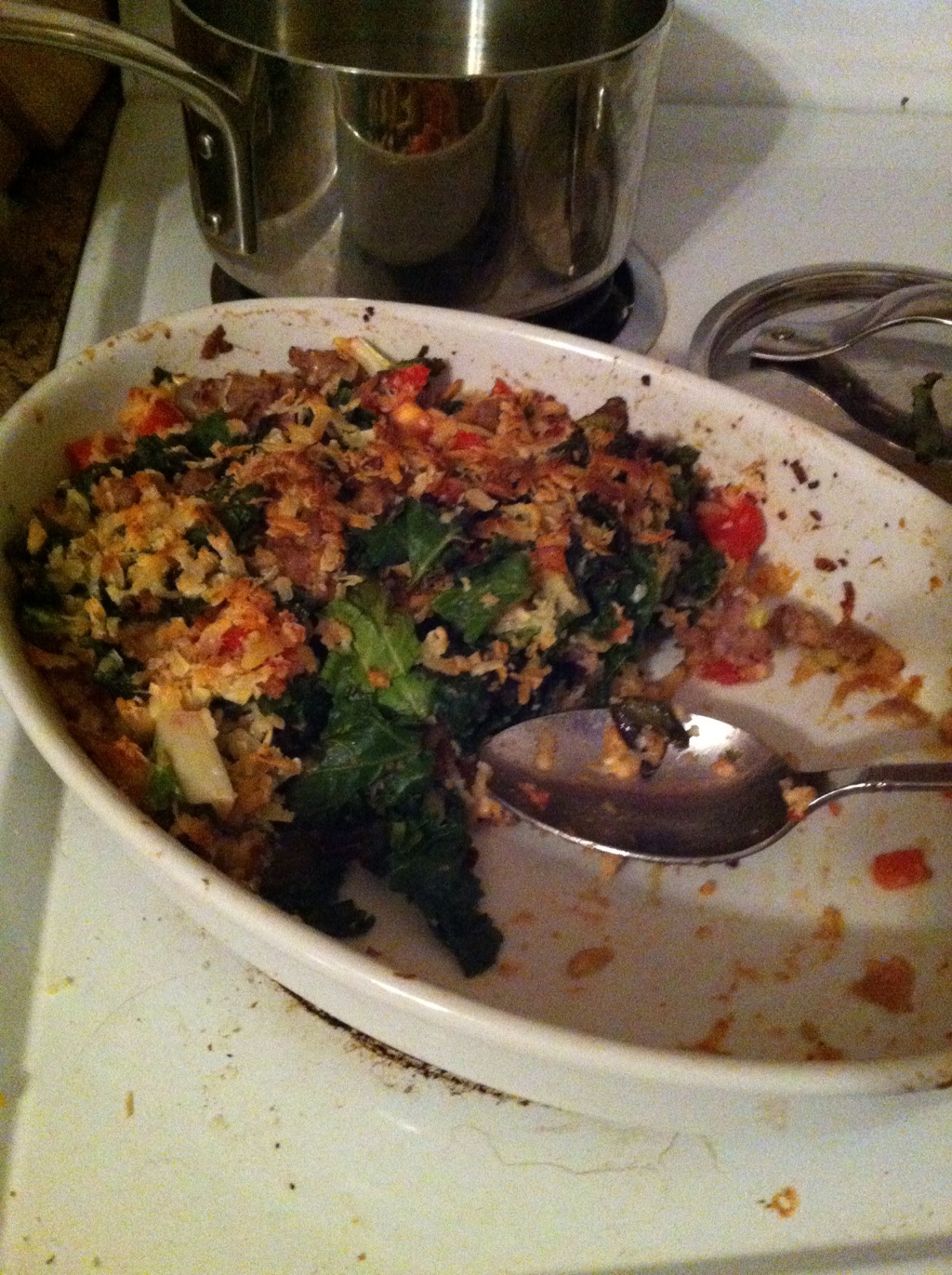
The recipe, such as it is:
2 medium sized bunches of kale
1 bunch of bock choy
1 bunch Swiss chard (you can substitute almost any green)
1/2 lb sausage chunks
Bread crumbs, 1 handful
6 oz smoked gruyere
1 tomato
First, blanch the greens, shock them in some cold water, and wring them out. Cut the leaves into bite sized pieces. While those are cooking, brown up some sausage. Then cut up a tomato. Finally, mix the ingredients with some breadcrumbs and cheese in a casserole dish and pop into the oven at 350 until warmed through.
There are plenty of variations. Perhaps next time I’ll try ricotta instead of smoked gruyere. It would totally change the character of the dish. Which is fine. A technique is always more handy to have than a recipe.
Putting Their Money Where Their Mouth Is
Since I’m taking unpopular positions on controversial topics today, I figured it would be a good time talk about some of the design choices in the new Retina Macbook Pro. A more descriptive name would probably be the Macbook Air Pro, but never let descriptions get in the way of good ad copy.
A lot of people are attacking Apple for not placing a very high priority on upgradability. The RAM is soldered to the logic board. The SSD, like the one in the Air, is proprietary (although I don’t think they’re compatible with each other). The screen is fused to the glass, so if there’s a problem you have to replace the whole top part of the machine. The battery is not user changeable (although that has been true for Apple’s mobile line up for years).
Some say Apple is being greedy. They’re trying to nickel and dime their customers for upgrades up front. After all, you don’t get to be the biggest company in the world by leaving money on the table. Others say that these were trade offs based on the company’s priorities. Modularity reduces efficiency. Best, Apple would say, to fit everything in as snuggly as they could. This helps them minimize the size while maximizing battery life.
I’m sure the answer is somewhere in between. Apple believes that customers will appreciate the benefits of the trade offs. Of course, they’re hedging this by keeping the old style MBP’s in the line up. This is how Apple does market testing. There are no focus groups or polling. They make what they feel is the best product they can. They ship it. It either sinks or swims.
Still, there’s one aspect I haven’t seen anyone mention. Yes, these new design choices make laptops that much more expensive to repair. If the RAM or screen go bad, a huge part of the computer will have to be replaced. But Apple is not asking customers to shoulder this burden entirely on their own. The cost of Applecare has not increased. Assuming that Apple will keep their level of customer service the same on this new device, I’d say they’re placing a pretty big bet themselves that these new processes will stand up.
Imagine you have a previous gen Macbook Pro covered under Applecare, and you find an issue with the stock hard drive or ram, or your screen starts to go. Apple will likely replace the parts that is defective and send you on your way. If you come in with a Retina Macbook Pro, they may have to replace an entire logic board. The price to you would be the same. $0.
Apple is betting on it’s ability to make these machines reliable. It can’t afford to give every Retina Macbook Pro customer 2 or 3 replacements over the lifetime of the warranty. I think this machine shows Apple’s confidence in their supply chain. They have to stand behind every one of these expensive little boxes. It’s a refinement of what they learned building the Airs.
Meanwhile, if the issue is the GPU, it doesn’t matter what model of laptop you have. You’re screwed. Those things have been soldered to the logic board for years for reasons of efficiency, and no one seems to mind. This is just the next step in a trend. Maybe you think this is a step too far, but it’s certainly not unprecedented.
 Nothing Was Delivered