Archive
There Have Been No Original Ideas In Your Lifetime
Proof that copyright overreach is not only a problem for the internet age. From a list of 13 aborted Hitchcock films:
4. Hamlet, starring Cary Grant
In the late 1940s, Hitchcock hit on an odd idea: he wanted to produce a modernized version of Hamlet set in England with Cary Grant in the title role. According to Hitchcock, the project “would be presented as a psychological melodrama.” The idea hit the rocks after Hitchcock’s studio, Transatlantic, announced the project and a professor who had written a modernized version of Shakespeare’s tale threatened a lawsuit.
You got that? A guy was literally going to sue Alfred Hitchcock over stealing the idea of stealing Shakespeare’s ideas. I’m honestly not even sure what law he thought he could sue under, but it was enough to scare off a big movie studio.
The idea is laughable now, but it seems that there was a point where let’s rewrite Shakespeare in a modern context seemed like a novel idea. Of course, writers have been ripping off Shakespeare since, well, Shakespeare’s time. The true innovation was to just cut the crap and call the damn film “Hamlet”.
In Defense of Jack Kerouac
“Stay in the flesh. Stay in the limbs and lips and in the belly. Stay in the breast and womb. Stay there, O Soul, where you belong”
— D.H Lawrence, Studies in Classic American Literature, on Walt Whitman
Art and Fandom will always be difficult to separate. Writers and artists tend to be complicated individuals who can appeal to different groups for vastly different reasons. Lasting art tends to be more than a symbol for a single idea, but instead is more like a collage of conflicting impulses. Naturally, some people will gravitate to a particular aspect of a song or movie or book that others may find peripheral. For example, you may enjoy the rustic country-rock of American Beauty while having no interest in living in a VW Microbus and living off nitrous and hash brownies. You may enjoy the depiction of the corruption of the American Dream in The Sopranos while understanding that ending sentences with “Fugetaboutit!” just isn’t funny.
Art can be pegged to times, places, philosophies, or aesthetics. Just as Johnny Cash’s later recordings will always represent the end of life, and Big Star will always remind you of that year you smoked a ton of pot and almost flunked out of college, for many of us On The Road will always mark the period where we started dipping our toes outside of the horizon we grew up with. It was a document that said that there were real choices in life, and it’s been a favorite of bored middle class teenagers for over 50 years.
On The Road has taken on a lot of baggage over the last several generations. There’s a definite sense of juvenile excitement. A rebellious, selfish, angry-young-man quality built in to the very premise of the novel that seems painfully, self consciously earnest at times. There comes a time when you start to worry about problems bigger than where to find the next apple pie and ice cream. Drifting from town to town, family to family, is no way to live a life. Worse than the text, even, are the folks who see this as a guide to life.
We’ve probably all met someone who read On The Road and saw it as a manual for escaping responsibility. Many of us went through that phase ourselves at some point. And much like any philosophy that requires you to live more deeply in some text than in real life, that attitude can be infuriating. So it’s not surprising, or even unfair, that at Katie J.M. Baker takes issue with Kerouac, and his fans.
“Whenever anyone tells me they ‘adore’ On The Road — which doesn’t happen that often because I don’t hang out with sixteen-year-olds”, she says, ” I can’t help but think she or he isn’t particularly well-read, just eager to come off as adventurous, spontaneous, and/or sexy. ” Fair enough. On The Road has become less a novel than a cultural token expressing a desire for some sort of “freedom”, which can mean whatever the speaker wants it to mean. But that’s not to say we should write Kerouac off.
Kerouac’s great contribution was not jumping in a car in search of adventure. I’d argue that his great contribution to literature was awe. Along with Allen Ginsburg, Kerouac was instrumental in keeping alive a sense of majesty that went back to William Blake and Walt Whitman. In the context of their studied contemporaries, the Beats stood practically mouth-agape. Baker laughs off the idea of “roman candles”, but maybe today more than ever we could use some wild eyed idealism. Cynicism is reductive. Jack Kerouac may have been a goddamned basket case, but he knew how to record a moment, his thoughts and neurosis and wonder, better than anyone of his generation. Pages and pages of nonsense scrawled in search of the perfect, transcendent collection of lines. It’s not a style that works for everyone. In fact, I don’t know that I’d recommend anyone follow purely in his footsteps. But I can’t help believing that somewhere between the perfectionism of David Foster Wallace and first thought, best thought lies some sort of truth.
Scotch-Bourbon-Rye
This is truly the cutting edge of whiskey technology. The Scotch-Bourbon-Rye blend. I am both excited and terrified to try this beast.
CSA Week 6: Fritters!
It’s week six and I think we’ve all had all the greens-sautéed-with-pasta as we can stand. Today the idea was for something a bit more substantial.
We decided on fritters. The farmers markets are full of Jersey zucchini, squash, and peppers. Mix those with whatever greens you have on hand, throw in some binder, and fry the suckers.
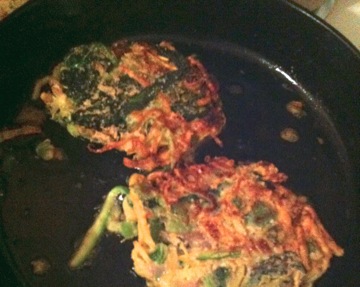
The recipe is easy enough. Cut two zucchinis in thin strips. Julienne, as they say. Dice up one green bell pepper and one shallot.
Blanche some greens. How much? Well, remember that when you cook greens, they’re going to shrink quite a bit, so the rule of thumb is to just way more than you think you’ll need. Clean them, stem them, and place them in gently boiling water for a couple of minutes, until the leaves start getting tender. Then quickly transfer to ice water to stop the cooking.
Then throw your zucchini, pepper, shallots, greens, and anything else diced or julienned that you feel like (any root vegetable would be pretty great, I thinking carrots next time) into a bowl. In a separate bowl, beat 1 egg with about 2 teaspoons of water, then pour it over your veggies. Salt and pepper liberally.
Meanwhile, get a cast iron skillet going with about 1/4 to 1/2″ of oil boiling. fill a dish with about 1/2″ of flour, and season with salt and pepper. Then take a handful of your veggie / egg collaboration and toss it in the flour. Take it out of the flour, form a patty, and pack it down pretty hard. They don’t need to be handled the the velvet gloves that burgers do. Squish them down, slide the fritter into your oil, and let it cook.
Once the fritter is browning on one side, flip it and cook on the other. That’s about it. You could serve with sour cream or guacamole. We happened to have some pesto mayo made up, so we used that. For a side dish we each had a handful of animal crackers ’cause we’re grown ups and we can do that, thank you very much.
Crocodile Found Wandering Ocean Gate, NJ
From the Asbury Park Press:
“The dangers speak for themselves when you have an animal such as this roaming loose in a compact residential neighborhood like Ocean Gate,” Fisher said. “Fortunately it wasn’t full-grown, but nevertheless, the dangers are still inherent.”
Every so often one of these creatures will make their way up the Intracoastal Waterway to the Jersey Shore. This time someone seems to have brought one up here on purpose and let it lose.
Boil Water Order Lifted for Long Branch
For Long Branch folks, try have lifted the Boil Water warning. Run the taps for a minute, and then go right ahead. The water’s fine.
Dispensing Advice Without a Licence
Agrigirl catches the State of North Carolina threatening a food writer with legal action for promoting his fad diet of choice.
Apparently the North Carolina Board of Dietetics/Nutrition has informed Steve that he is unable to give readers advice on diet, whether free or for compensation, because in doing so he is conducting the unlicensed, and therefore criminal, practice of dietetics. The North Carolina Board went on to tell Steve that even his private emails and telephone calls with readers and friends are illegal, as is his fee-based coaching. Steve was left with a red-lined document letting him know what he can and cannot say without a government-issued license from the North Carolina Board of Dietetics/Nutrition.
This sounds almost comically over the line. While I have no love for people trying to profit off the latest fitness trends, this is almost the definition of a slippery slope. What is next, are not going to be allowed to discuss nutrition with friends or coworkers for fear that someone is part of a secret Diet Police? Will parents be banned from teaching their children how to cook, for fear they may use hydrogenated fats?
Nutrition is important, and it’s complicated and hard to get right. Looking back, I wish that my parents had been stricter about the foods we ate. I was well into my 20s before I learned to eat right and settled at a fairly healthy weight. I understand the government’s impulse to keep the quacks at bay. But food is too much a part of everyday life. It fills our Instagrams and forges friendships. And, not to put too fine a point on it, it gives bloggers something to ramble on about. There are ways to encourage healthy eating that are better than trying to control who talks about food. This is America, damnit. We all talk about food.
Putting Their Money Where Their Mouth Is
Since I’m taking unpopular positions on controversial topics today, I figured it would be a good time talk about some of the design choices in the new Retina Macbook Pro. A more descriptive name would probably be the Macbook Air Pro, but never let descriptions get in the way of good ad copy.
A lot of people are attacking Apple for not placing a very high priority on upgradability. The RAM is soldered to the logic board. The SSD, like the one in the Air, is proprietary (although I don’t think they’re compatible with each other). The screen is fused to the glass, so if there’s a problem you have to replace the whole top part of the machine. The battery is not user changeable (although that has been true for Apple’s mobile line up for years).
Some say Apple is being greedy. They’re trying to nickel and dime their customers for upgrades up front. After all, you don’t get to be the biggest company in the world by leaving money on the table. Others say that these were trade offs based on the company’s priorities. Modularity reduces efficiency. Best, Apple would say, to fit everything in as snuggly as they could. This helps them minimize the size while maximizing battery life.
I’m sure the answer is somewhere in between. Apple believes that customers will appreciate the benefits of the trade offs. Of course, they’re hedging this by keeping the old style MBP’s in the line up. This is how Apple does market testing. There are no focus groups or polling. They make what they feel is the best product they can. They ship it. It either sinks or swims.
Still, there’s one aspect I haven’t seen anyone mention. Yes, these new design choices make laptops that much more expensive to repair. If the RAM or screen go bad, a huge part of the computer will have to be replaced. But Apple is not asking customers to shoulder this burden entirely on their own. The cost of Applecare has not increased. Assuming that Apple will keep their level of customer service the same on this new device, I’d say they’re placing a pretty big bet themselves that these new processes will stand up.
Imagine you have a previous gen Macbook Pro covered under Applecare, and you find an issue with the stock hard drive or ram, or your screen starts to go. Apple will likely replace the parts that is defective and send you on your way. If you come in with a Retina Macbook Pro, they may have to replace an entire logic board. The price to you would be the same. $0.
Apple is betting on it’s ability to make these machines reliable. It can’t afford to give every Retina Macbook Pro customer 2 or 3 replacements over the lifetime of the warranty. I think this machine shows Apple’s confidence in their supply chain. They have to stand behind every one of these expensive little boxes. It’s a refinement of what they learned building the Airs.
Meanwhile, if the issue is the GPU, it doesn’t matter what model of laptop you have. You’re screwed. Those things have been soldered to the logic board for years for reasons of efficiency, and no one seems to mind. This is just the next step in a trend. Maybe you think this is a step too far, but it’s certainly not unprecedented.
Mo Money, Mo Problems?
I recently got into an argument on Facebook with a friend of mine about monetary policy. Since that forum is really more conducive to funny memes and reports of cute things one’s kids said/did/broke that morning, I thought I would take the discussion out to the internet at large, where anyone and everyone can stop by to tell us where we’re full of shit.
Economic theory isn’t really my strong suit. I’m more of a song and dance man. Still, while I respect my friend’s opinion about monetary policy, something about it doesn’t ring true.
My buddy, you see, is a Hard Money die hard. He believes that no matter their intentions, just about any attempt by the government or central bank to kick start the economy will only make matters worse in the long run. In his words:
Basically I believe in Austrian School and Chris believes in Keynes. Everyone talks about austerity being a bad thing. It’s not. People tend to forget that government cannot create money in a real sense, it can only take it. If you count on the government to put people to work you will eventually have a currency collapse unless it’s paid for. The reason the Depression lasted as long as it did WAS because of the actions of Hoover and Roosevelt. Had Hoover done nothing the Depression would have been over in two years.
The market is a self sustaining organism. The 1920 Crash happened and the resulting Depression was over in 16 months. Reason was Harding did absolutely nothing EXCEPT for imposing import tariffs which made domestic goods more attractive.
This strikes me as comparing apples and oranges. First off, lets take a look at this chart:
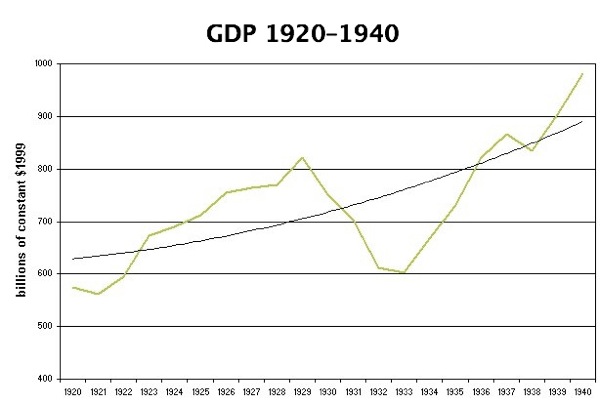
This shows US GDP in the interwar period. Look at the recession of 1920 compared to what followed in 1929. We’re talking about events of vastly different scopes. The causes were different, the politics were different, and the scales were different. That big dip at the end of the roaring 20’s is really an historical anomaly.
I’m not an expert in the Great Depression, but the idea that a more laissez-fair approach by the Hoover Administration would have ended the Depression within 2 years (FDR didn’t come into office until 3 1/2 years into the Depression) doesn’t make sense. If you look at the timeline, the economy was basically in freefall until the New Deal began, when we finally started seeing positive growth.
It seems to me that FDR did the best that he could. The length of the Great Depression was a function of the hole that we found ourselves in after nearly 4 years of fumbling around in the dark. I can’t imagine that growth could have been significantly steeper had Roosevelt come into office and sat on his hands. But I’m not really the guy to re-argue the Great Depression. This whole thing started with us talking about what could be done here, and now.
Obviously something’s not working. Income inequality is at an all time high. Official unemployment is struggling to stay at 8%. For better or worse, the government body we have tasked with fixing the economy is not Congress or the Presidency, but the Federal Reserve. The Fed has basically 2 options in front of them. Tightening up the monetary supply by raising interest rates, or printing money and dropping it from a helicopter. Instead, for the past couple of years, they’ve opted for neither.
My friend continues:
But all printing money is going to do is to raise prices. We need DEFLATION, not Inflation. The person on a fixed income would be more than happy to see prices go down.
Lets just stipulate that any monetary policy has winners and losers. The goal of government policy should be to increase the welfare of the overall population. Imagine that we were in a situation of deflation today. (Current inflation is so low that this isn’t very hard.) If prices started falling, this could be good in the short term for some people. Folks on a fixed income would, for instance, benefit, by being able to stretch their dollars farther. But over all the economy cannot grow with deflation. Falling prices would mean retailers, wholesalers, manufacturers, and those in the service economy would all find themselves pulling in less income for the same amount of work. They would be forced to lay off employees. The average spending power of the economy dips for every lay off. With fewer and more frugal customers, retailers will find themselves with unsold goods and service providers with unutilized services. In order to compete, they will likely have to resort to a combination of lower prices and lay offs, and the cycle continues. This is a terrible hole to have to dig out of.
The other option is to pump more money into the economy. You need to remember that modest inflation is not generally desirable in and of itself (though it could be useful to many underwater home owners after a real estate crash such as the one we had in 2007 , as mortgages are set in real dollars). Inflation is a natural outcome of a rebounding economy. As unemployment starts going down, the newly flush are going to want to splurge a bit. They have probably been in a bad financial situation for a while, and as soon as they start getting steady checks again, you’ll see them looking to move out of the room at they’re relatives house they’ve been staying at. They’ll need to decorate that new apartment, and will have to go out and buy furnishings. It will be time for the car repairs they’ve been putting off. Maybe they can finally get married to their sweetheart and hire a caterer, book a hall, and register at Pier One. All of these things will, in aggregate, boost the economy. The retailers, manufactures, and caterers involved will all eventually need to hire on people to fill the demand. But in the short term, we’ll see prices rise. The temptation for the Fed will be to put on the breaks by raising interest rates, but that would only cause another slump.
“What about hyperinflation?!?!”, you ask. “Weimar Republic? Zimbabwe?” Okay, calm down. Yes, we can all agree that hyperinflation is very bad. But when faced with the very real problem of structural unemployment right now, and the phantom problem of maybe, someday, having runaway inflation, isn’t it best to worry about the problem at hand? People are suffering today because they can’t find work, can’t pay their bills. The reason for that is there’s not enough money going around. Meanwhile, inflation is at historical lows. We should be using every tool in the book to stimulate demand. Half measures will not fix the problem.
Can Someone Tell Me What Club Soda Is?
Erin and I stocked the bar today. I bought Old Granddad. Erin got some sort of cheap gin and enough tonic to cure malaria. Since they were having a special, she planned on getting club soda as well.
Here’s the things we recently got one of those Sodastream machines that puts fizz in your water. I argued that this made store bought club soda obsolete. Take water, add CO2 and booze. You’ve got yourself a cocktail. She is convinced that what you get out of this machine is seltzer, not club soda.
In this case, it doesn’t appear that the Internet can help settle the matter. People seem to use the terms interchangeably. I did notice that the club soda bottles at the store had sodium bicarbonate – baking soda – listed in the ingredients. The bottles of seltzer contained nothing more than carbonated water.
I’m not too concerned. I’m sure that no matter what comes out of that contraption, after the second scotch and whatever-that-is, you’ll be hard pressed to pay it any mind.
 Nothing Was Delivered