Archive
Mo Money, Mo Problems?
I recently got into an argument on Facebook with a friend of mine about monetary policy. Since that forum is really more conducive to funny memes and reports of cute things one’s kids said/did/broke that morning, I thought I would take the discussion out to the internet at large, where anyone and everyone can stop by to tell us where we’re full of shit.
Economic theory isn’t really my strong suit. I’m more of a song and dance man. Still, while I respect my friend’s opinion about monetary policy, something about it doesn’t ring true.
My buddy, you see, is a Hard Money die hard. He believes that no matter their intentions, just about any attempt by the government or central bank to kick start the economy will only make matters worse in the long run. In his words:
Basically I believe in Austrian School and Chris believes in Keynes. Everyone talks about austerity being a bad thing. It’s not. People tend to forget that government cannot create money in a real sense, it can only take it. If you count on the government to put people to work you will eventually have a currency collapse unless it’s paid for. The reason the Depression lasted as long as it did WAS because of the actions of Hoover and Roosevelt. Had Hoover done nothing the Depression would have been over in two years.
The market is a self sustaining organism. The 1920 Crash happened and the resulting Depression was over in 16 months. Reason was Harding did absolutely nothing EXCEPT for imposing import tariffs which made domestic goods more attractive.
This strikes me as comparing apples and oranges. First off, lets take a look at this chart:
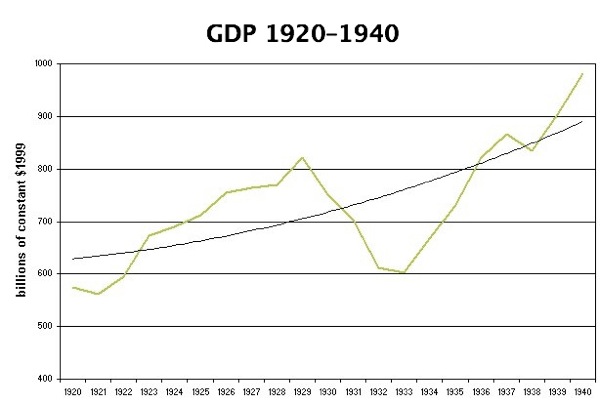
This shows US GDP in the interwar period. Look at the recession of 1920 compared to what followed in 1929. We’re talking about events of vastly different scopes. The causes were different, the politics were different, and the scales were different. That big dip at the end of the roaring 20’s is really an historical anomaly.
I’m not an expert in the Great Depression, but the idea that a more laissez-fair approach by the Hoover Administration would have ended the Depression within 2 years (FDR didn’t come into office until 3 1/2 years into the Depression) doesn’t make sense. If you look at the timeline, the economy was basically in freefall until the New Deal began, when we finally started seeing positive growth.
It seems to me that FDR did the best that he could. The length of the Great Depression was a function of the hole that we found ourselves in after nearly 4 years of fumbling around in the dark. I can’t imagine that growth could have been significantly steeper had Roosevelt come into office and sat on his hands. But I’m not really the guy to re-argue the Great Depression. This whole thing started with us talking about what could be done here, and now.
Obviously something’s not working. Income inequality is at an all time high. Official unemployment is struggling to stay at 8%. For better or worse, the government body we have tasked with fixing the economy is not Congress or the Presidency, but the Federal Reserve. The Fed has basically 2 options in front of them. Tightening up the monetary supply by raising interest rates, or printing money and dropping it from a helicopter. Instead, for the past couple of years, they’ve opted for neither.
My friend continues:
But all printing money is going to do is to raise prices. We need DEFLATION, not Inflation. The person on a fixed income would be more than happy to see prices go down.
Lets just stipulate that any monetary policy has winners and losers. The goal of government policy should be to increase the welfare of the overall population. Imagine that we were in a situation of deflation today. (Current inflation is so low that this isn’t very hard.) If prices started falling, this could be good in the short term for some people. Folks on a fixed income would, for instance, benefit, by being able to stretch their dollars farther. But over all the economy cannot grow with deflation. Falling prices would mean retailers, wholesalers, manufacturers, and those in the service economy would all find themselves pulling in less income for the same amount of work. They would be forced to lay off employees. The average spending power of the economy dips for every lay off. With fewer and more frugal customers, retailers will find themselves with unsold goods and service providers with unutilized services. In order to compete, they will likely have to resort to a combination of lower prices and lay offs, and the cycle continues. This is a terrible hole to have to dig out of.
The other option is to pump more money into the economy. You need to remember that modest inflation is not generally desirable in and of itself (though it could be useful to many underwater home owners after a real estate crash such as the one we had in 2007 , as mortgages are set in real dollars). Inflation is a natural outcome of a rebounding economy. As unemployment starts going down, the newly flush are going to want to splurge a bit. They have probably been in a bad financial situation for a while, and as soon as they start getting steady checks again, you’ll see them looking to move out of the room at they’re relatives house they’ve been staying at. They’ll need to decorate that new apartment, and will have to go out and buy furnishings. It will be time for the car repairs they’ve been putting off. Maybe they can finally get married to their sweetheart and hire a caterer, book a hall, and register at Pier One. All of these things will, in aggregate, boost the economy. The retailers, manufactures, and caterers involved will all eventually need to hire on people to fill the demand. But in the short term, we’ll see prices rise. The temptation for the Fed will be to put on the breaks by raising interest rates, but that would only cause another slump.
“What about hyperinflation?!?!”, you ask. “Weimar Republic? Zimbabwe?” Okay, calm down. Yes, we can all agree that hyperinflation is very bad. But when faced with the very real problem of structural unemployment right now, and the phantom problem of maybe, someday, having runaway inflation, isn’t it best to worry about the problem at hand? People are suffering today because they can’t find work, can’t pay their bills. The reason for that is there’s not enough money going around. Meanwhile, inflation is at historical lows. We should be using every tool in the book to stimulate demand. Half measures will not fix the problem.
Can Someone Tell Me What Club Soda Is?
Erin and I stocked the bar today. I bought Old Granddad. Erin got some sort of cheap gin and enough tonic to cure malaria. Since they were having a special, she planned on getting club soda as well.
Here’s the things we recently got one of those Sodastream machines that puts fizz in your water. I argued that this made store bought club soda obsolete. Take water, add CO2 and booze. You’ve got yourself a cocktail. She is convinced that what you get out of this machine is seltzer, not club soda.
In this case, it doesn’t appear that the Internet can help settle the matter. People seem to use the terms interchangeably. I did notice that the club soda bottles at the store had sodium bicarbonate – baking soda – listed in the ingredients. The bottles of seltzer contained nothing more than carbonated water.
I’m not too concerned. I’m sure that no matter what comes out of that contraption, after the second scotch and whatever-that-is, you’ll be hard pressed to pay it any mind.
Let’s Pizza!
Robot pizza machine whips out a pie from scratch in 3 minutes. Hey, it can’t be any worse than Pizza Hut. Welcome to the future.
The Farthest Away
Voyager 1 is set to become the first man made object to leave the solar system. it boggle the mind.
Voyager is not out there, yet. “But,” cautions Stone, “we don’t know. I mean this is the first time any spacecraft has been there.” Since nothing’s ever been there before, we don’t know what it will look like, which makes it a little hard to recognize “it” at all. “That’s the exciting thing,” he continues.
The Hardest Part Of Wanting Is Knowing What You Want
**Moonrise Kingdom Spoilers**
Wes Anderson films all center around childhood. Sometimes we adults dealing with the fallout of growing up. Sometimes we see the parents who struggle to accept how they raised their children. The transition from kid to grown up is always painful and awkward. There is always a basic lack of empathy separating one generation from the next, and it ends up damaging everyone involved.
Moonrise Kingdom is interesting because we’re not coming in years after the fact. There’s still hope for these kids. Sam and Suzy have been having a hard time of it lately, but now that they’ve found each other, maybe they’re not fated to wandering the earth as miserable as the characters from The Darjeeling Limited.
The unspoken truth of adolescence is that most of us have to struggle through it alone. There’s a gulf between you and everyone around you because you’re too hopped up on hormones to articulate you’re feelings. The frustration of youth is knowing exactly what you want but not being able to explain it.
Wes Anderson drops us in to the lives of these characters at a point where they still haven’t settled. They strongly know the kind of life they want, and somehow stumbled upon one of the few other people in the world who feels the same way. They can’t really talk about it, but that’s okay, because each of them already knows what the other one wants. It’s an immediate bond, and one that the the adults in the film don’t understand because they’ve never had anyone else know what they want.
Desire is problematic. Fitting your life into a vague sense of place is difficult, so you compromise. You cut corners. Eventually you wake up one day and find yourself in a Talking Heads song. Sam and Suzy have found the best lifeline you could ask for in surviving growing up. They found a partner.
Is This Green Hair Dye Still Good?
In a way, “Punk Rock Girl” resembles a gleefully brain-damaged version of an R.E.M. song that had been released a few months prior and was still in heavy rotation on Teletunes (and inside my brain) at the time: “It’s The End Of The World As We Know It (And I Feel Fine).” But where R.E.M. crafted a Pollock-like canvas of pop-culture expressionism, The Dead Milkmen hocked a loogie on it.
Jason Heller of the AV Club reminisces about The Dead Milkmen and makes me want to break out my Doc Martins. “Punk Rock Girl” will always remind me of my youth, but I didn’t discover it it was almost a decade old. Luckily, some things never change.
CSA Week One
I wasn’t exactly born a city boy, but considering my connection with nature, I might as well have been raised on the Lower East Side. If I go too long without hearing a car I get nervous. I couldn’t tell clay soil from cat litter. I wouldn’t want to live anywhere out of walking distance from a good slice joint (we’re missing one in the West End, but that’s a whole other post).
The point is I don’t even own a single pair of overalls. Working the earth has never been my specialty. So I was a little hesitant to get up at 6 am and go work in a field. And pay for the privilege. Still, kale don’t grow itself. Or maybe it does. As I stated, I’m still not clear on how this stuff works.
Last summer I joined a CSA near by. Every week I would drive out there early in the morning, before the sun was it it’s most evil, and pick some greens, tomatoes, okra, whatever happened to be ready. In real life, unlike in supermarkets, crops tend to grow on a micro-seasonal schedule. You’ll have a handful of weeks when certain fruits and veggies are perfectly ripe, at the peak of their freshness and flavor. The following week anything that hasn’t been picked is looking it’s age, like a Real Housewife after her fourth Pino Gris and not enough sunscreen. Pretty soon it needs to be plowed under to make way for the next round, and something else is blooming a few rows down.
I really enjoyed the challenge of this. How much kale is too much kale? There’s only one way to find out. See how many meals you can make out of it. Creativity always comes out of restrictions. How much great art has been created because a starving artist couldn’t afford to buy more paint and was forced to use what she had at hand? Food’s the same way, except you get to eat it afterwards. It’s a comment on transience of life. It’s also delicious.
Last year was an experiment. This year I’m more prepared. I’ve also agreed to help out. Today I had to till the soil between rows of onions. Got to push this big plow looking thing. Worked with a downright medieval looking contraption called a stirrup hoe. And I’m proud to report the onions are no worse for wear. Mostly.
For a couple hours of work, I got to walk out of there with a big bag of kale, some bok choy, and red leaf lettuce. Erin already has visions of kale chips dancing in her head. I’m thinking noodles with peanuts and stir fried bok choy. The hard part isn’t so much the tilling and the planting and the harvesting. It’s not even coming up with ideas on how to use bushels of greens. It’s just finding the time to cook all this.
Sherlock Holmes and The Case of the Missing Quantum
When I was a kid, my cousin gave me a copy of The Adventures Of Sherlock Holmes for Christmas. I read most of it by the end of Christmas vacation. I was fascinated by the deductive method. “Once you eliminate the impossible, whatever’s left, however improbable, must be the truth”.
I ready more and more detective stories. Some were part of the Western canon, others were comic books. It didn’t matter to me. It’s been a while since I read a good detective story, but I’m still libel to turn on an episode of Law and Order every so often to get my fix.
Modern detectives don’t work the same way Sherlock Holmes did. In the post War era, a private dick would basically bumble around asking questions until someone slips up. Later films turned to share the point of view of the criminals. Modern sleuths use science to such an exaggerated extent that lawyers bemoan the CSI Effect.
Recently, Sherlock himself has come back in a big way. I’ve been watching the BBC adaptation, and I love the way the writers attempt to stay true to the deductive style of original stories, even as they obnoxiously modernize the aesthetic (I get it. It’s the 21st Century. Can we stop with all the lens flare and talk about blogs?).
But something seems sort of, well, antiquated about the way he solves crimes, and I think I’ve put my finger on it. It’s Quantum Physics.
The fact of the matter is that the character was invented in an era before quantum physics. Before we understood uncertainty. Before the pervasiveness of chance in the world around us was part of our conversation.
Consider a case Sherlock Holmes solves in the finale of Series 1 (each BBC “Series” consists of 3 hour-and-a-half long mini-movies). Sherlock interviews someone loosely connected to a murder victim, and judging by a tan line, an itch, and some Columbian currency that the whole thing was a set up. The idea is that for every effect, you can follow a single chain of causality back to an elegant solution.
However, we broke that chain decades ago. Most people today don’t understand quantum physics. It’s not taught as part of a standard curriculum. It’s not discussed in mainstream media in great detail. There’s a reason for that. It’s really, really complicated and unintuitive. But I think that the ideas generated by the last century of study has permitted the public consciousness. We have a sense that not everything is as it seems. Actions and consequences aren’t as tightly linked as we suspect. The world is random sometimes crazy shit just happens. Sherlock Holmes doesn’t get that.
Luckily, the writers of the BBC series get it. They poke a bit of fun at the character’s over confidence. But it still makes our hero seem a bit of a relic. Detective work today is mostly luck, mixed with a bit of science and psychology. There’s a reason why most of the great literary sleuths 1 come from the early 20th Century or so. That’s the last time we could be certain about anything.
- FOOTNOTE ↑
Of course, Columbo could be considered an exception, but his whole schtick was that he seemed like an anachronism.
Pretzels
At some point, an adrenaline junky may find himself zip-lining down the side of thousand foot cliff along side the Yellow River. As his feet brush the tops of trees and his life flashes before his eyes, he may think back on the path that led him there. It seems that, as with any form of addiction, you begin to need ever greater doses to get your rocks off. What started out as an affinity for water skiing could eventually end up as a series of of ever more ridiculous stunts just to inject a bit of excitement into a an otherwise tired and featureless life.
Baking can be a lot like that.
I say this because any normal person who wants a soft pretzel will simply go to his supermarket freezer isle and pick up a box that you just throw in the microwave for 3 minutes. If only life could be that simple for the gluten junky. For some of us, the idea that we want pretzels turns into a week long ordeal that involves whiskey, George Clinton, and pH levels. To be honest, I probably would have drank whiskey and listened Funkadelic that night even if there were no pretzels, but I don’t think my friends would have come by just booze and music. The pretzels sealed the deal.
Pretzels are, like many baked goods, easy enough to make at home, but difficult to get quite right. Part of the problem is that traditional pretzels are soaked in an alkaline solution before baking. Real bakers use lye could easily be a bumper sticker sold at county fairs and restaurant supply stores throughout the country.
There are various ways to approximate that perfectly tanned pretzel exteriors. One common trick is to use baking soda in place of the lye. It’s cheap, accessable, and just alkali enough to get the job done without causing chemical burns. But for some reason I remembered reading about another secret, and some quick googling led me to a Times article from two years ago (who knew I had such a great memory for baking related minutia?) about increasing the pH of baking soda by, well, baking it.
So a week ago I began making preparations for the big day. I baked a box of baking soda. While the powder came out looking exactly the same as it went in, I did notice a serious burning in the back of my throat when some dust got kicked up. Next I went on line and spent a rather crazy amount of money on pretzel salt, because I knew Morton’s topped pretzels were not going to cut it.
Following with my new, devil-may-care baking attitude, I decided to wing the recipe. I figured that since bagels and pretzels are sort of cousins, and I had made 55% hydration bagel dough a few weeks ago (see here for a quick primer on baking percentages. They don’t work the way you think they do.). So I whipped up a simple dough with 55% hydration, a sprinkeling of salt, a tablespoon of Active Dry Yeast (which is is probably more than I needed, but this dough was going to have a short ferment) and few pinches of sugar to get the yeasties going. Whoever said that baking was more of a science than, say, grilling, didn’t realize that, with both, the secret ingredient is confidence. Hubris, really. After all, if it goes wrong, who cares? It’s just flour and water.
Wile the dough was rising, we started drinking. Fermentation was a common theme that night.
Boiling is what separates the pretzels from the breadsticks. Since we were experimenting, I filled a wok with 6 cups of water, and mixed in a half cup of baked soda. Erin and I weighed out 3 oz portions of dough and rolled them into misshapen pretzel-like blobs. I boiled four of them, two at a time, for about 2 minutes each, splashing water over top of them. Then I slid them onto my pizza stone, which had been preheating for an hour or so in a 450º oven.
I didn’t take any pictures, but trust me when I say that these came out almost perfect. There was still… something I couldn’t quite put my finger on. The crumb was tight. Could have used a bit more salt, is all. The outside had bite and a color a bit like beige leather carseats. I was looking for something closer to Tanned Mom. I thought to myself, if a half cup of baked soda gives results this good, another half cup will be twice as good! More is always better!
So I upped the pH of the water even more and cooked the last 4 pretzels. This time I flipped them in the water, to make sure that the whole thing was appropriately soaked.
I noticed something was off right away. The outside of the pretzels seemed dimpled. They appeared shriveled, like raisins.
I panicked. I had gone too far. Pushed the limits. Should have left well enough alone. Meanwhile, my friends were in the next room expecting more pretzels. I didn’t have a back up. Maybe they wouldn’t notice.
No such luck. When I pulled the pretzels out of the oven, they didn’t just look like leather, they felt like it. Once they cooled, we all manned up and tried one. They had a bitter, sharp taste. Pretty unpleasant. Stronger than you would have gotten from plain baking soda, I think. pH giveth, and pH taketh away.
Experimenting can be fun. Be bold. Be foolish. But learn to recognize when you find what you were looking for.
 Nothing Was Delivered